02EikusPrivate beta · iPhone
 EIKUS
A time machine back to your newborn days.
Language is learned only by guessing in real situations, not by being taught in a classroom. For two thousand years, people have rediscovered this road, only to watch it run aground. The road was not wrong; it was too costly to build. Two thousand years, and what came was not a better teacher; what we waited for was a time machine to send you back to childhood. Eikus is that time machine.
#1 · The script library
17,125 scripts so far, and more on the way. Every new word arrives among words you already know.
Each script is one short scene built around one word or phrase to teach, and the library is built like a spiral: a scene is placed only after the words around its new word have been taught. Then later scenes keep using the word in passing: a word taught in the first 1,500 scripts comes back in a median of 32 later scripts.
This is how every child gets a mother tongue: never from a word list, always one unknown thing inside a world that already makes sense. No textbook is built this way. Here the order itself is computed, scene by scene, across five levels: concrete things you can see (L1), chunks and reactions (L2), grammar and abstract words (L3), everyday speech (L4), academic words (L5).
- 17,125
- scripts so far, placed one by one and released step by step
- 17,039
- of them bring an earlier word back in a new scene
- 81%
- contain no word you haven’t met in an earlier script, except the one being taught
- 11
- words in an average script were taught by earlier scripts
Data: the Eikus script library as of 16 November 2026, more on the way, and the app’s reading cards. In the second step each script counts as a video already watched, in release order.
#2 · The reading area
On every card in the reading area, 100% of the words come from short videos you have watched.
The reading area is not a textbook. Its cards are written ahead of time, and every word on them is taken from the lines of the videos: the ten cards of the trial only from the fourteen trial videos, the others from all the videos online. Every card has a picture, and the picture is there as evidence.
Eikus keeps the words of every video you watch. After 30 videos beyond the trial, the reading area opens. A card is shown to you only once every word on it has come up in the videos you have watched, at most two more cards for each video. The words you have heard decide which cards you can read.
- 32
- reading cards so far, each with text and narration in seven languages
- 100%
- of the words on a card have come up in videos you have watched
- 2
- more cards at most for each video you watch
- 30
- videos beyond the trial before the reading area opens
#3 · One video
You see one video. Behind it is a whole folder.
Take this 15-second scene: a guard stops a visitor who has no badge. Its package holds 216 files, 432 MB: the picture in seven languages, each with the mouths re-made for that language; seven sentences with start and end times; a separate voice track for each of the two characters in each of the seven languages, 14 in all; her footsteps in the last shot, on a track of their own; the script, the keyframes, the self-checks of every lip-sync.
Eikus uses each part on its own. The picture changes with the language you are learning. Dub the guard, and only the guard’s voice is taken away: the visitor keeps speaking in your target language, and the app silences her lines in your recording. Or dub both roles yourself in one take. Record your voice alone, or record video with your face in a small window. Press and hold, and the shot loops, stopping before the next line begins. A video file alone could do none of this: having the videos is not enough.
- 7
- languages, each with its own lip-synced picture
- 14
- voice tracks: two characters in seven languages
- 3
- ways to dub: either character, or both yourself
- 216
- files, 432 MB, behind 15 seconds
Data: the folder of “badge”, the scene in the app’s trial area that also carries its dubbing guide.
- Do not stop to count what you have gained.
Wherever you count,
there the seal falls again.From now on, for every short video, you never need to “confirm you understood.” If you don’t swipe it away, it repeats on a loop by itself. When you feel you understand, just swipe up to the next one. In Eikus there is a stream of short videos you will never get to the end of; what matters most is to “keep going.” - Reduce, and reduce again,
until there is nothing to lean on:
then ability appears.Your native language is not the “foundation” of learning a foreign language; it is the greatest blocking factor. Eikus offers no native-language help of any kind. Understanding the meaning relies entirely on guessing, just as when you mastered your native language. Building a new language ability does not require doing “more things.” Removing the substitutes is far harder than “trying a little harder.” At its core, Eikus is not about learning the target language; it is about breaking the dependence on your native language. - Great confusion is the rite of entry;
whoever is never confused in a lifetime
stays outside the door for a lifetime.“What am I doing?” “What have I learned?” After only a few videos you are already in the zone: bewildered. You have started to feel insecure. Good! Just like when you first came into the world: until you had mastered your native language, you were in a daze the whole time. It is as if you have walked into a fog on a dark night: there is light in the distance, and under your feet everything is uncertain. If you still have the courage to rush into the uncertainty and embrace it, your abilities will grow fast, and not only in language. - Words never travel alone.
Every sentence that enters
must bring a world
as its guarantee.Every line has evidence in the picture; characters, props and settings are strictly continuous, and no shot needs words to explain it, because from the very start of their design they were required to be “understood by guessing, without relying on any words.” - The oracle never answers questions;
it is only willing to appear once more.In the listening-and-speaking area, Eikus never lets you see any written words; you don’t need to look anything up, and it will certainly give no explanations. Any hint, lookup or explanation … is not your judgment; it is someone else’s conclusion. Language has never entered the brain through word lists and rules; every clue you need is in the picture. What you cannot hear, you can see; what you cannot guess in this one, the next one will give you again. - Prophecy:
when the input is endless,
and for you alone,
the seal comes undone by itself.Eikus has no fixed curriculum. What each person is sent is different, yet it precisely matches your current level in the target language. Where you linger, how many times a video loops, which one you swipe away after one viewing … all of it is recorded and used to decide the next one sent to you. That “just able to understand” feeling is not a coincidence; it is calculation. The AI is adjusting everything for you alone. - The Way has no steps.
Wherever you meet steps,
you have already strayed into the temple.Mastering the target language in Eikus has no stages and no levels. Dividing learning into “stages” is itself misleading. Language ability is not acquired at some stage. Think of your own native language. When judging, correcting and judging again keep taking turns, at some moment the language appears in the form of intuition. This appearance does not need to be announced, and it cannot be verified in advance; it is confirmed only when you find that you no longer depend on any outside tool. - The keepers of the seal
mostly do not know it.
They do not stop you from coming near;
they understand for you.Eikus has no explanations and no tests. Language cannot be “taught” to you by someone else, because language is an ability, and an ability cannot be handed over. The clearer the explanation, the less you guess; faced with a second language, you have never really guessed at all. The only measured number recorded in your account is the time you have truly spent inside the target language. The measure must shift from “whether you understood” and “whether you remembered” to “whether you keep going.” - Asceticism
is a virtue invented
by people who kept a back door.
Infants have no such virtue;
they simply have no door.Eikus has no daily check-ins and no levels to clear. Language is not mastered through self-discipline, but through mechanism. What use is self-discipline inside a mechanism that does not work? Humans mastering their native language need no self-discipline; they simply have no way back. Why would someone with no way back need self-discipline? - Guessing right is stealing fire;
opening your mouth
is lighting the fire
directly on your own tongue.Every short video in Eikus can be dubbed. Choose a character, and the other characters play opposite you. Or play several parts yourself. You can record your voice, or a video. There is no score. Nobody grades the speech of a babbling toddler. - Arrival has no ceremony.The sign that your language ability has truly improved is not your vocabulary size, not scores, not levels. The true sign is: you no longer feel anxious about not understanding; you begin to catch clues in the target language, guessing attitudes, emotions and where things are heading. Until one day you find that a concept is actually awkward to say in your native language, while the target language comes out naturally. At that moment you have already entered the target language, and you can go anywhere.
- Written words are the shadows of sounds.
A shadow without a body:
you have seen a ghost.Writing belongs here, and all of it comes from the short videos you have watched. The language you have heard, guessed and already lived in the videos shows its face here for the first time. - Stop the river
and ask it what water it is.
By the time the answer is in hand,
the river no longer flows.The reading area has only one rule: do not look up words. Because you simply do not need to. Even if there is a word you don’t know, keep reading. A sentence you are unsure of: keep reading. If you cannot guess it, keep reading too. Looking up a word is not a neutral act of learning; it is a definite switch of systems. Your goal is not “to understand this piece”; it is that the judging keeps going. Understanding language never requires certainty; it only requires being able to keep going. - A word in the dictionary is an orphan;
in a sentence, its whole clan travels with it.“Guessing” in reading is not random speculation; it is a highly structured process of reasoning. To guess a word, there are far more clues than you think. The sound of the word itself carries emotion and color. Then there is its position in the sentence, the shape of its beginning and end, its repeated appearances, which over long reading form a stable network of recognition, so that abstract concepts gradually become predictable. And there is the picture, perhaps the most direct evidence. - Half guessing the human heart,
half guessing the world.The texts in the illustrated reading area come in two kinds: fiction and nonfiction. Fiction: stories, characters, settings; what you guess is the plot and the emotions. What you follow is the human heart. Nonfiction: how the real world works; what you guess is the facts. What you follow is cause and effect. The two come before you at random, without any label. In fact, from the sound of the reading voice, you can easily tell them apart. - The crutch’s last lesson
is to make you firmly believe:
without the crutch, you will fall.
On the day you cast it away,
only the crutch falls to the ground.At its core, Eikus is a call for a more honest view of learning. Admit uncertainty; accept vagueness. This takes courage, because it asks us to give up the crutches that make us feel safe. Learning a new language is not only training yourself to use a new tool; it is recalibrating our understanding of “learning.”
#1 · Reading cards
The picture’s job is not to decorate;
the picture’s job is to testify.
Every reading card comes with a picture. The picture is not decoration; it is a clue: whatever happens in the words, the picture holds the evidence. This is the logic of the picture books humans read as small children. Read the way you leafed through picture books as a child; now there is even a voice reading along with you.

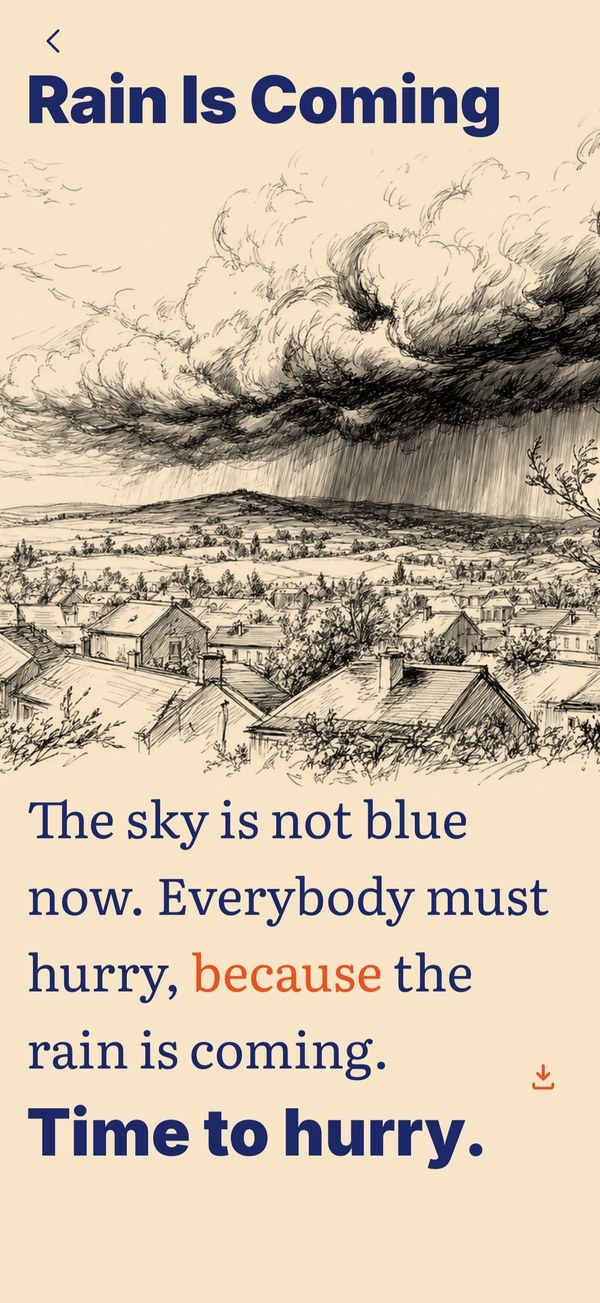
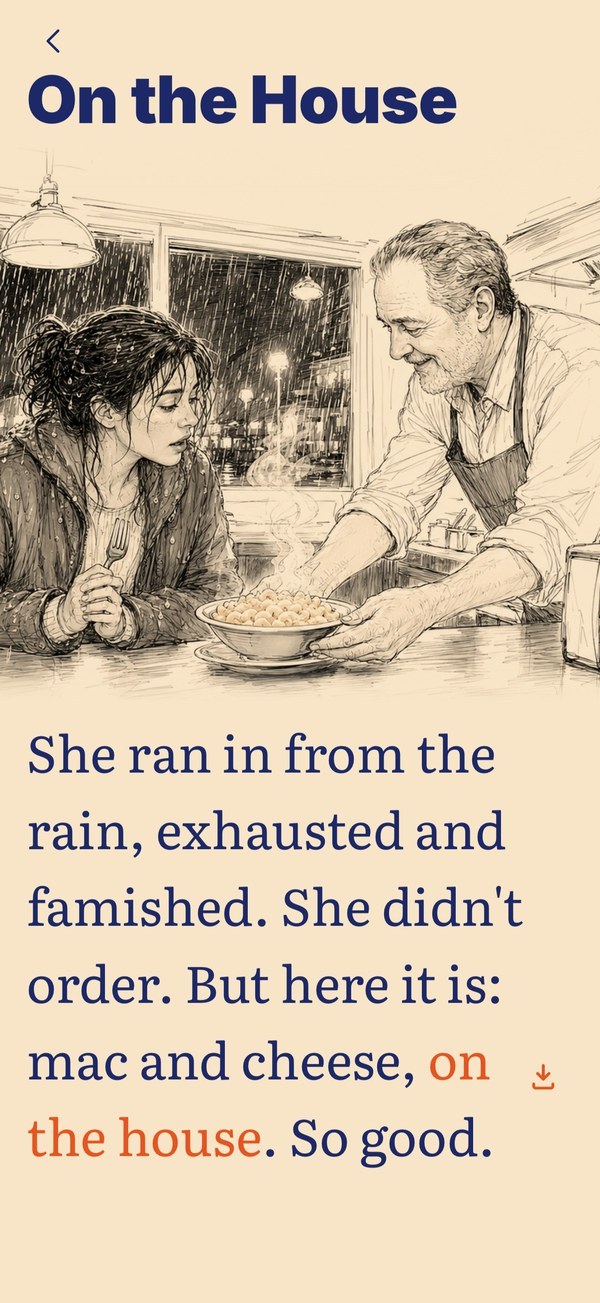
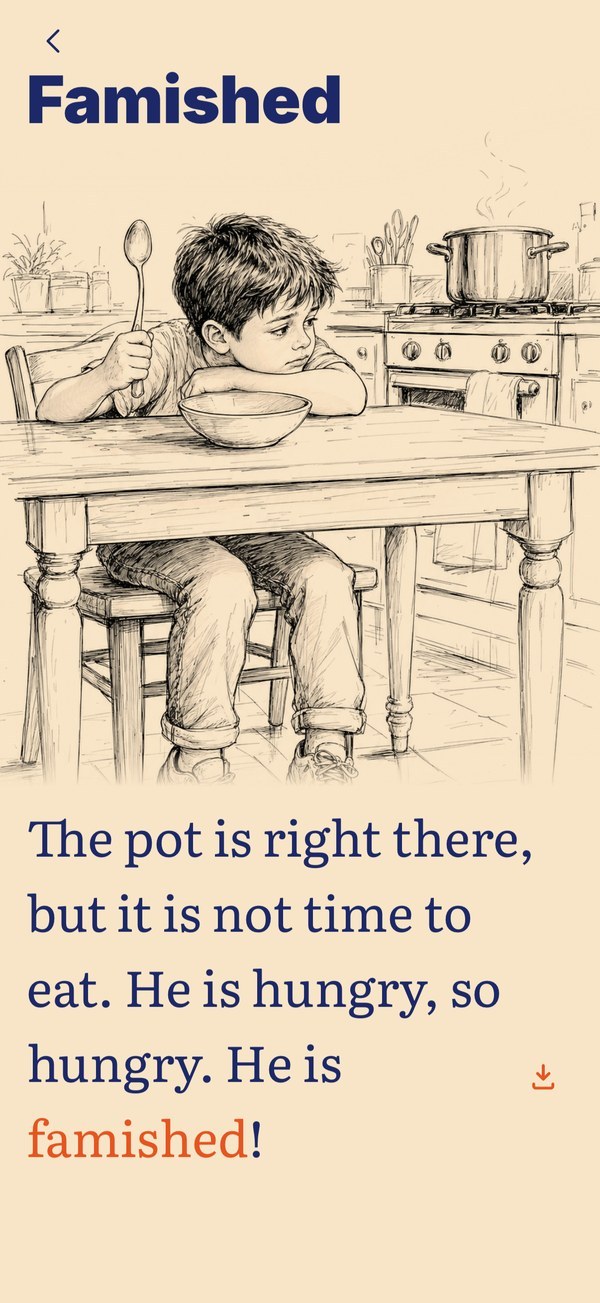
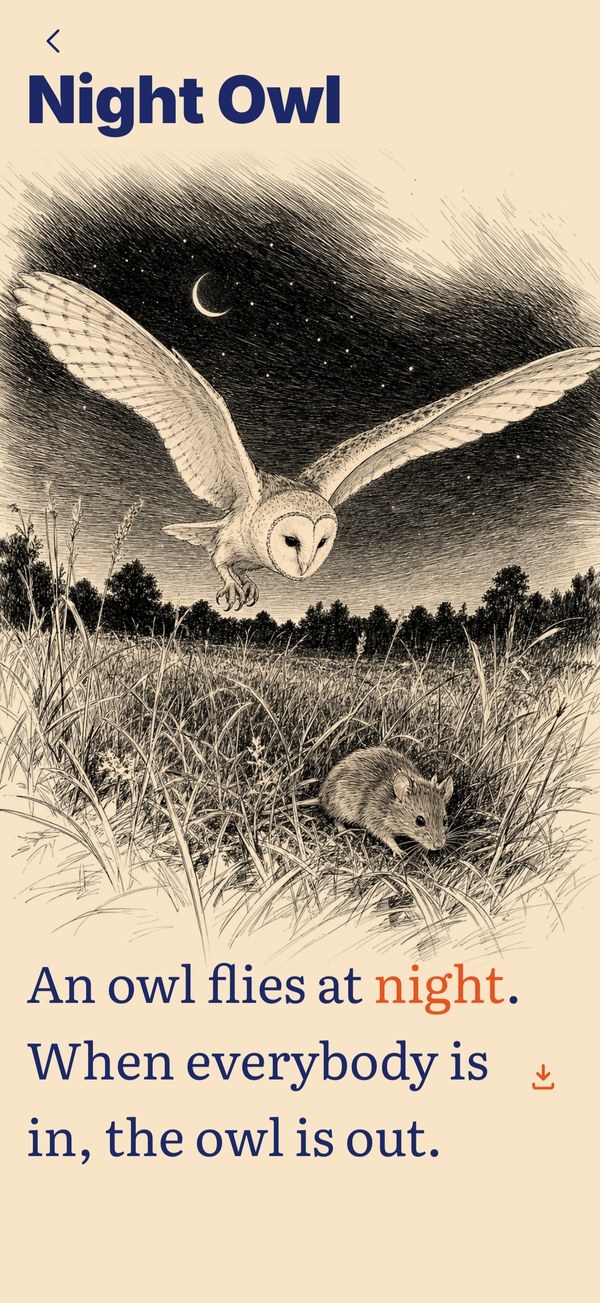
Text and narration in all seven languages.
#2 · Inside the app
Feed · dubbing · account
Status
- iPhone
- Private beta (TestFlight)
- App Store
- Coming
- iPad · Android
- Not yet
- Price
- Not final
- Start in
- 15 native languages
- Privacy policy · pending
- Press kit · pending
#3 · Questions
Why no subtitles?
Elsewhere there are subtitles, translations, vocabulary lists, scripts, line-by-line explanations … here there is none of it. When you gained the ability to understand and speak your native language, none of those things were there. Those things are certainty; they are knowledge.
What if I guess wrong?
When did a newborn ever “confirm” anything? Don’t ask; guess again. Guessing wrong is no crime; the crime is demanding the answer.
How is Latin pronounced?
Classical (restored) pronunciation, with c as [k] and v as [w].
Is my dubbing public?
No. Your dubs can be downloaded and saved, and they are also saved automatically to “My dubs” in your account.
Can I learn more than one language?
Yes. Eikus has seven: English · Español · Français · 日本語 · 한국어 · 中文 · Latina. Each language is its own stream with its own progress, and you can add or remove languages at any time.